Made by ELD teachers for ELD teachers, Speak Agent addresses the root cause of the achievement gap—the language barrier.
Most math and science programs limit their support for Multilingual and English Learners to vocabulary reference tools. Their strategy is to make the academic vocabulary more accessible to ML and EL students. This is a worthy goal, but it has not proven effective.
The Current Strategy Is Not Effective
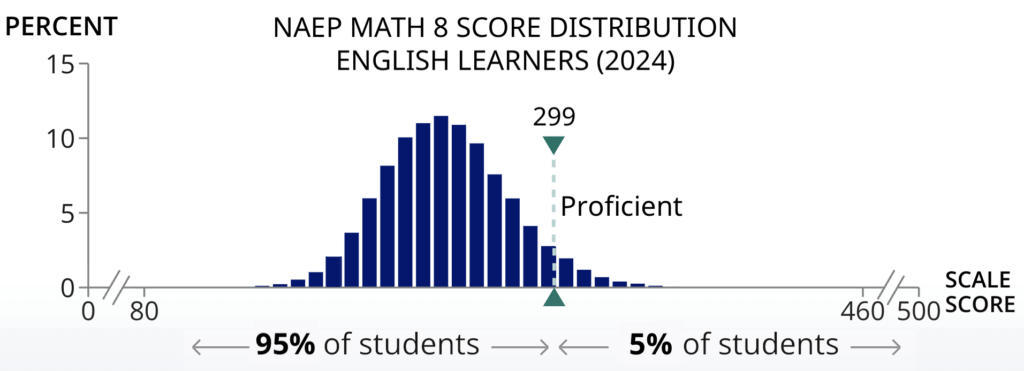
Source: NAEP 2024, Performance by Student Group.
In 2024, 95% of English Learners did not achieve Proficient on the NAEP 8th Grade Math assessment. Less than one in four achieved Basic. On a national level, there has been no sustained progress for many years. While many individual localities and teachers may experience varying degrees of success, how do we scale and sustain progress?
How Your Multilingual and English Learners Can Outperform in Math and Science
Speak Agent addresses the root cause of the STEM achievement gap for ELs—the language barrier—rather than just making content more accessible. Our Math + Language and Science + Language programs take a comprehensive language approach, applying evidence-based strategies to support MLs and ELs of all levels.
As a result, in addition to gains in math and science, students using Speak Agent also see gains on their ELD assessment. The chart below shows the mean change score on the WIDA ACCESS for ELs assessment with use of Speak Agent.
Predicted Mean ACCESS Scale Score
N = 5,361, p<.001
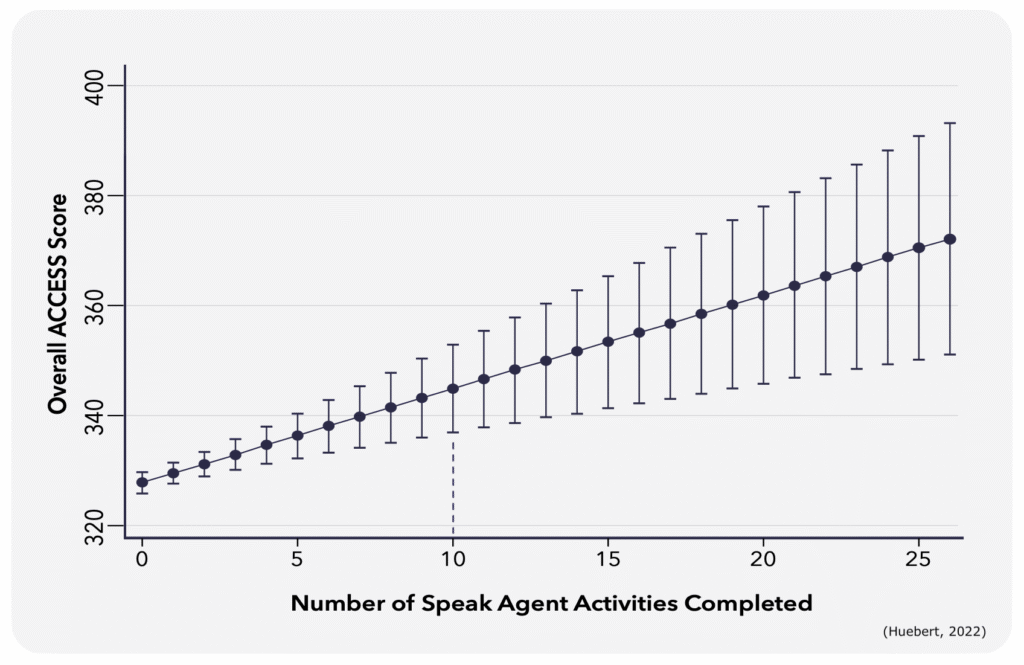
Source: Huebert, 2022
The following table shows the mean effect size, by ACCESS domain, at a dosage of 10 learning activities per month (30 to 60 minutes of use per week):
| ACCESS Domain | Effect Size |
|---|---|
| Speaking | +22 points |
| Listening | +20 points |
| Writing | +18 points |
| Reading | +13 points |
| Comprehension | +15 points |
| Literacy | +16 points |
| Oral | +21 points |
Speak Agent Works Because It Is Evidence-Based
Speak Agent goes far beyond isolated vocabulary practice and rote learning. It promotes an effective language development approach that includes learning supports in every language domain. With Speak Agent, students engage in dialogic reading, morphology and sentence processing games, scaffolded writing activities—even creating their own math problems—all designed to develop comprehension of key academic concepts in varied contexts.
Learning Supports Embedded into Speak Agent
Speak Agent seamlessly integrates all six communication modes with your school district’s curriculum. Follow the links below to see specific examples:
Correlated to Standards
WIDA ELD Standards
Learn how Speak Agent supports the WIDA 2020 ELD Standards Framework here.
Correlated to Content Standards
Speak Agent products are all correlated to CCSS, NGSS, and your state academic standards. So, your English Learners are not only practicing language, but are doing so within your standards framework. Standards correlations may be found on each page under our Programs menu.
Integrate Speak Agent with Any Program Model
Speak Agent supports all of the ELD and bilingual program models in the table below.
| Program Model | Language(s) of Instruction | Language Goals | Use of Primary Language (L1) |
|---|---|---|---|
| Mainstream or General Education | Instruction is in English. | English proficiency | No L1 support. |
| Structured English Immersion | Instruction is in English with pull-out or plug-in ESL instruction. | English proficiency | L1 support. |
| Sheltered Instruction | Instruction is in English with sheltering support for academic content learning. | English proficiency for academic use | L1 support. |
| Newcomer | Intensive instruction is in English for one year or less. Students are separated from mainstream classrooms. | Transition to English instruction in sheltered or mainstream classrooms | L1 support; family component; modified classroom instruction. |
| Early Exit Transitional Bilingual | L1 is used to teach academic content as a bridge to English. English is increasingly used to 2nd or 3rd grade or for 2–3 years in grades 7–12. | Transition to English instruction | Students taught in both L1 and English; transfer to English-only programs after 2–3 years. |
| Late Exit Transitional Bilingual | L1 is used to teach academic content. English is increasingly used to 5th or 6th grade or for 4–5 years in grades 7–12. | Transition to English instruction | Students transfer to English-only programs after 4–6 years. |
| Maintenance Bilingual | L1 is used to teach literacy and academic content along with English. | L1 maintenance and English proficiency | L1 is sustained along with gradual development of English. |
| Dual Language | L1 and English are used to teach literacy and academic content. | Full bilingualism and bi-literacy for social and academic purposes | Students use both languages to learn language and academic content in two languages. |
Please see our References page for a full A to Z listing of all research cited on speakagent.com.